Predictive Maintenance: maintenance before something fails
A cooling compressor that runs longer every day, a pump that draws more power for the same work: baiond notices the drift early, tells you which device and why, and helps you plan the repair before it becomes an emergency.

In one sentence
Predictive Maintenance in baiond is a function that learns how each connected machine normally behaves and warns you when it starts to drift, often well before it fails.
Many breakdowns announce themselves. A compressor runs a little longer each day, a motor draws a little more current, a room takes longer to reach its temperature. The signs are in the data long before the alarm – they are just too small to see on a single reading.
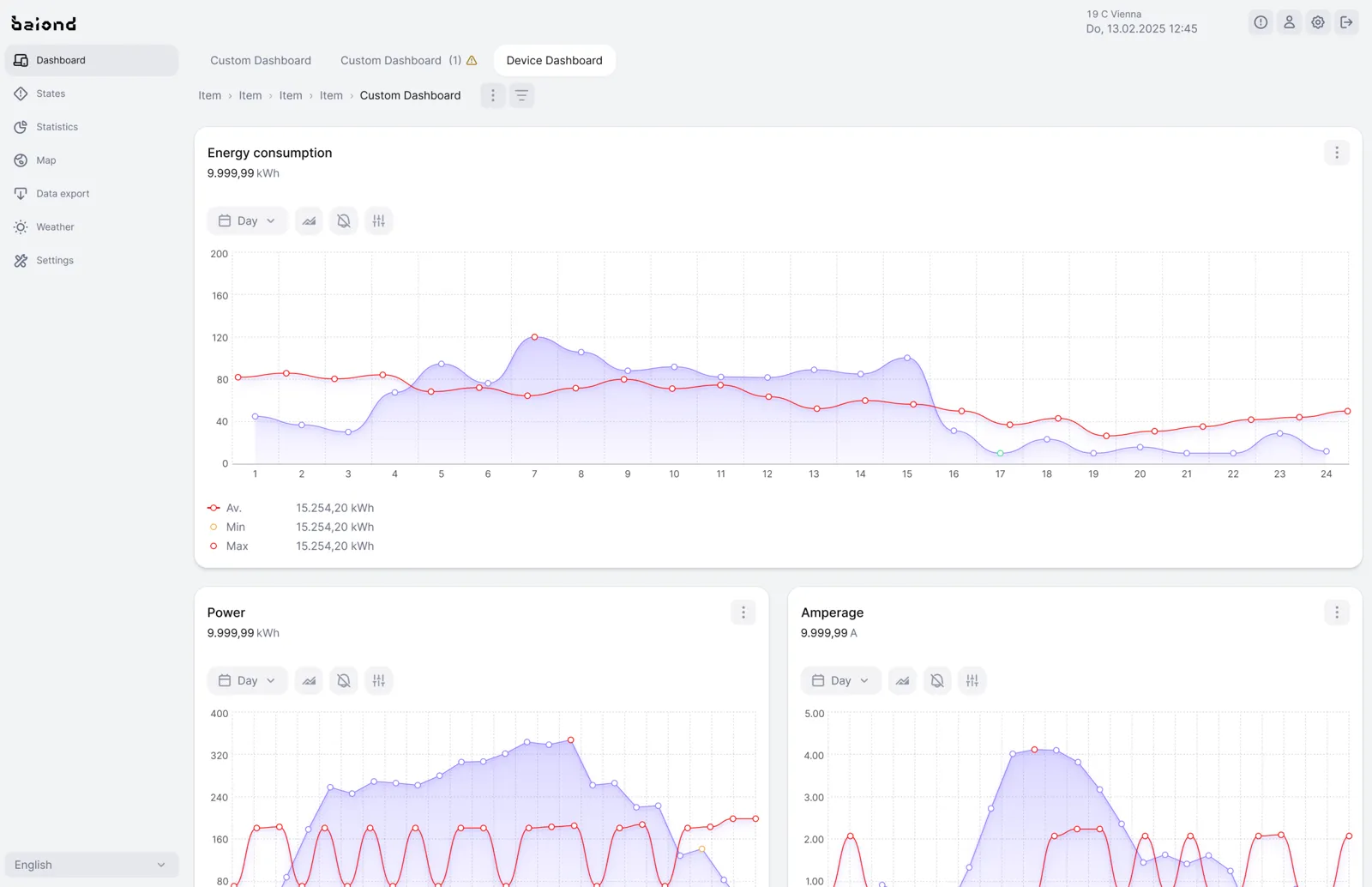
baiond learns what normal looks like for every connected device, from its own history and the weather around it. When the pattern shifts, it tells you in plain words: which device, how far it is off, since when, and what usually causes it. A hot week is far less likely to trigger a false alarm, because baiond takes the heat into account.
In a supermarket, that means the cold room compressor that has run 19.6 hours a day instead of 15 is on the technician's list this week – not on Saturday afternoon, when the fish counter is full.
What changes for you.
-
Repairs you plan, not emergencies
You see a drift early, often weeks ahead, and book the technician for a quiet morning instead of paying the weekend call-out.
-
Fewer false alarms
Baselines account for weather and season, so a hot week reads as a hot week, not as a broken machine.
-
Maintenance by condition
Service the devices that need it and skip the ones that do not – with the readings to show why.
See it answer.
A question only this function makes answerable, answered the way baiond answers: readings, reasons, a recommendation and the source.
Checked Energy meter · Temperature sensor · baiond Gateway · Predictive Maintenance How did baiond know?
- Sensor
- baiond Gateway
- Space System
- AI agent
The sensor reports to the baiond Gateway, the Space System puts the reading in context (location, threshold, history), and the AI agent turns it into an answer.
Source: Energy meter · Temperature sensor · baiond Gateway · Predictive Maintenance
- Run time / day 19.6h
- Normal 14–16h
- Outside temp. 18.2°C
Yes, in cold room 2. Its compressor now runs 19.6 h a day against a normal 14–16 h, and the curve has risen for 11 days while the outside temperature stayed around 18 °C. The weather does not explain it – the machine does.
Check the door seal of cold room 2 today and book the refrigeration technician this week. baiond keeps watching the run time and tells you if it climbs further.
Shall I show you the run time of the last 30 days?
Looking closer. This is what the data shows:
Possible reasons- A worn door seal lets warm air in, so the compressor runs longer
- Low refrigerant charge reduces cooling capacity step by step
- A fouled condenser coil makes every cycle less efficient
The sensor reports to the baiond Gateway, the Space System puts the reading in context (location, threshold, history), and the AI agent turns it into an answer.
- Sensor
- baiond Gateway
- Space System
- AI agent
Source: Energy meter · Temperature sensor · baiond Gateway · Predictive Maintenance
Understood. I keep watching Store 12 · Cold room 2 and let you know if anything changes.
For technical readers
Protocols, data model and integration, for the colleague who signs off on the architecture.
- Modbus
- BACnet
- M-Bus
- MQTT
Inputs
Any time series that describes a device's work: energy and current, run times, temperatures, pressure, humidity, counts. Existing building automation is read through the baiond Gateway; weather data comes in as context.
- Sensor and meter data (LoRaWAN, M-Bus, Modbus, BACnet, MQTT)
- Local weather: temperature, humidity, rainfall, wind
- The device's own history
Detection
baiond builds a baseline per device from its history and compares every new reading against it, adjusted for weather and time of day. It flags gradual drift (rising run time, falling efficiency), sudden changes and unusual cycling, and ranks devices by how far they are off.
Alerts & planning
- Thresholds and sensitivity per device or per group in the Space System
- Notifications in the app and by e-mail, with the readings attached
- Maintenance windows and the history of every intervention in one place
Integration
Predictive Maintenance runs on the data baiond already collects – often without extra hardware where meters and controllers exist. Results are available to the AI agents, so you can ask "Which devices need service this month?" and get a ranked answer.
One station in the data flow.
Related industries
Where this function carries the answer.
-

-

-

-



Related sensors
The sensor families that feed it most often.



Ready to give your data a voice?
Thirty minutes with the baiond team about your site and your questions. No slides.
Request a consultation